For a freelancer, time tracking is money tracking. There's no salary smoothing over a forgotten hour and no colleague to double-check your invoice, if you don't capture the time, you simply don't get paid for it. The challenge is that freelancers juggle several clients at once and rarely want to spend their limited admin time wrestling with complicated software. Chronixo and its Time Tracking are one option, but the criteria below matter whichever tool you pick.
Key Takeaways
- Every untracked hour is lost income. With no salary to fall back on, a freelancer who forgets to log time gives it away for free.
- Simplicity beats features. A freelancer needs fast, frictionless tracking, not an enterprise suite they'll avoid using.
- Per-client separation is essential. Hours must stay cleanly attributed to each client without manual sorting at invoice time.
- Invoice-ready exports save real admin time. Tracked hours should flow straight into a bill, since you're the one doing the billing.
- Affordability matters at solo scale. The tool has to make sense for one person's budget, not just a funded team's.
Why Freelancers Need Time Tracking Software
A freelancer operates without the safety nets a salaried employee or agency team takes for granted. That changes what time tracking is actually for:
- Your time is your entire income. Unbilled hours don't just reduce a project's margin, they come straight out of your pay.
- You juggle multiple clients simultaneously. Switching between three or four clients a day makes it easy to misattribute or lose time without a tool tracking it.
- Clients may ask for proof. A clear, itemized record of hours turns a potential billing dispute into a non-issue.
- There's no one else to catch mistakes. No PM, no finance team, if you don't track it accurately, nobody will fix it for you.
Because accuracy directly affects what you earn, it's worth understanding the full evaluation picture before choosing. Our how to choose time tracking software guide covers the features and trade-offs in depth.
What to Look For as a Freelancer
Freelancers have almost the opposite priorities from a large team. Weight these heavily, and don't pay for what you won't use:
| What to prioritize | Why it matters for freelancers |
| Simplicity and low friction | If tracking is tedious, you'll skip it, and skipped tracking is lost income |
| Per-client / per-project separation | Keeps hours cleanly attributed without manual sorting at invoice time |
| Invoice-ready exports | Turns tracked time straight into a bill, since you handle your own billing |
| A real-time timer | Capturing time as you work beats reconstructing it from memory later |
| Affordable at solo scale | The pricing has to make sense for one person, not just a team |
| Works across your devices | Freelancers move between laptop, phone, and locations |
What you can usually ignore: team management, complex approval chains, utilization dashboards, and admin controls built for managing other people. Those add cost and complexity without helping a solo operator bill more accurately.
The Freelancer's Real Enemy: Untracked Time
Ask most freelancers where they lose money and they'll point to rates or late-paying clients. But the quieter, more constant drain is untracked time, and it's uniquely a freelancer problem because there's no system around you to catch it. The five-minute "quick question" call. The revisions that crept past the original scope. The email thread that took 40 minutes but never made it onto an invoice. Each feels too small to log, and that's exactly why they vanish.
On a team, a project manager might notice scope creep and flag it. As a freelancer, you're the PM, the finance department, and the person doing the work, all at once. The only thing standing between you and steadily leaking income is a tracking habit that's frictionless enough to actually maintain. That's why simplicity isn't a nice-to-have for freelancers, it's the whole point: a tool you'll actually use beats a powerful one you won't.
Getting your rate right matters too, and it depends on knowing your real hours. Practical guidance on how to set a freelance rate starts from exactly that: understanding where your time actually goes.
Chronixo captures time by client with a one-click timer and clean exports, so billing takes minutes and no hour goes unpaid. Try it free for 14 days.
Start Free Trial →How Chronixo Works for Freelancers
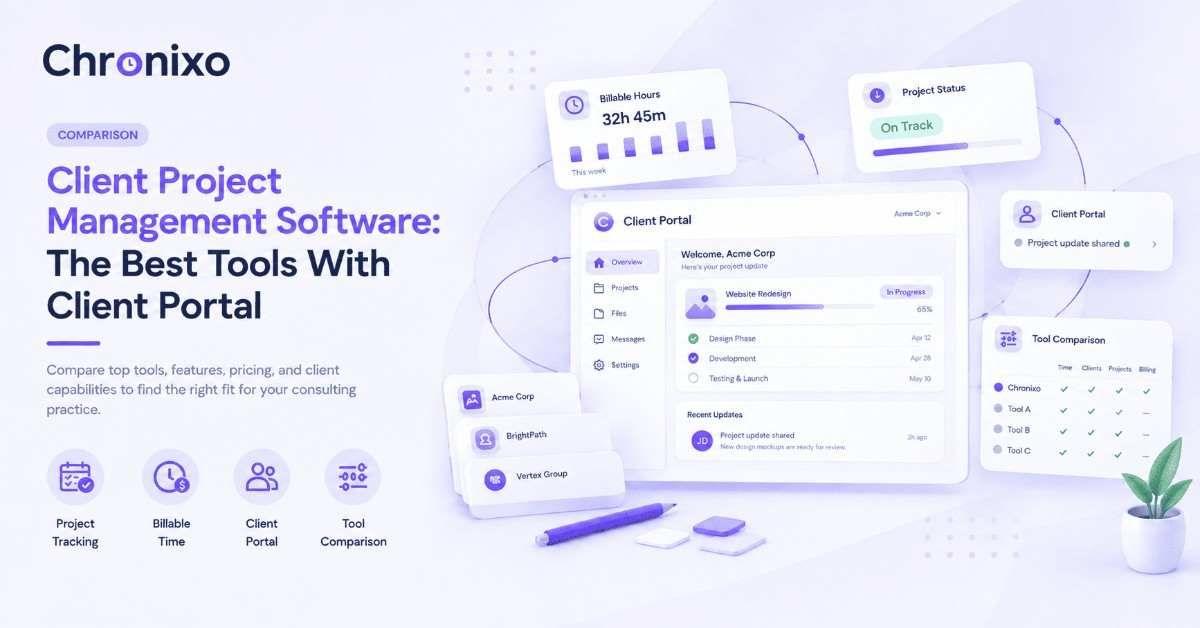
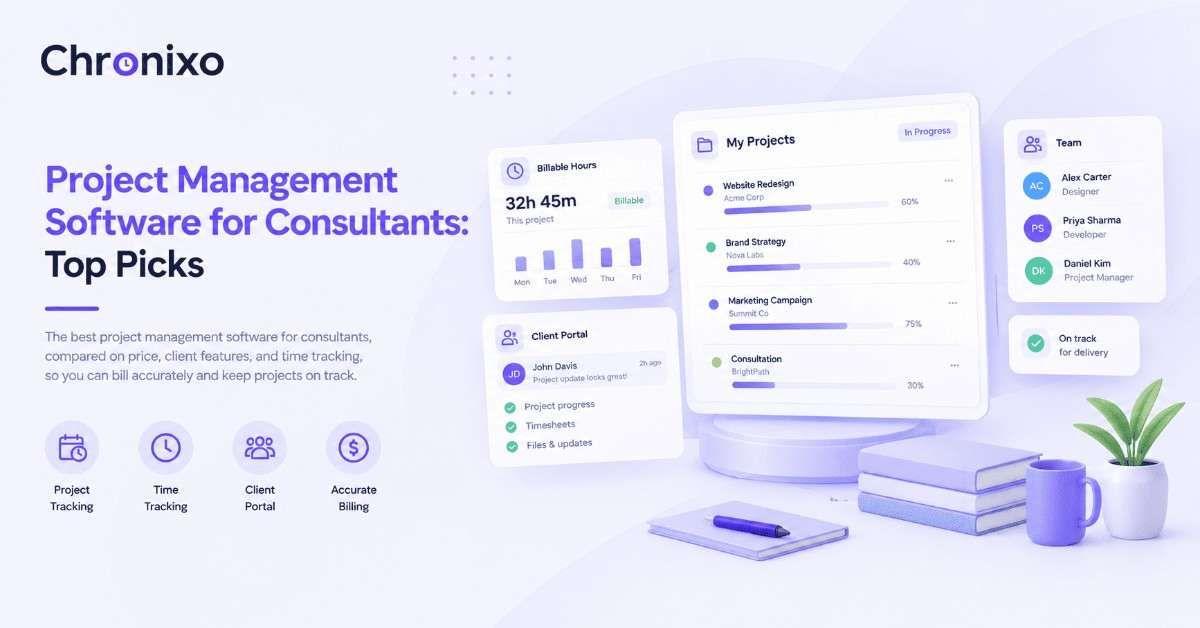
An honest note on fit: Chronixo is built primarily for teams and agencies, its full strength (approvals, client portals, workforce analytics) is aimed at groups managing client work together. For a solo freelancer, some of that is more than you need. But the core Time Tracking works just as well for one person: a real-time timer tied to each client, clean per-client records, and one-click exports for invoicing.
Where Chronixo makes the most sense for a freelancer is if you're scaling, about to bring on a subcontractor or two, or you want the client-portal polish that makes you look more established than a solo operator. If you're planning to stay strictly solo forever, a lighter tool may be all you need, and that's a fair call. Either way, the 14-day free trial (no credit card) lets you test it against real client work before deciding.
Freelancers and independent consultants share almost identical billing pressures, so if your freelance work leans consulting, that guide covers the same ground from the consulting angle.
Read more: Time tracking software for consultants
Next Steps
For freelancers, time tracking software has one job above all: make sure you get paid for every hour you actually work. That means simple, low-friction tracking, clean per-client separation, and exports that turn your hours straight into an invoice. The fanciest tool won't help if it's too fiddly to use, so prioritize the one you'll actually keep up with.
If you're a freelancer starting to feel the limits of manual tracking, or eyeing growth toward a small team, Chronixo is worth a look. Start a 14-day free trial with a live client project and see whether it captures your hours the way freelance work demands.